Charlie Haden is one of the foremost bass players in contemporary jazz. In the 1950s Haden was a part of the first Ornette Coleman Quartet, which was the center of a jazz revolution. He has been involved with both avant-garde and mainstream jazz ever since. In the 1960s he formed the Liberation Music Orchestra, whose pointed political references were controversial. Haden re-formed the Orchestra in 1983 and their latest album is "The Ballad of the Fallen." Haden also plays with the band Old and New Dreams, made-up of Coleman alumni.
Cy Coleman started his career as a jazz pianist and club owner before moving on to writing pop songs that were recorded by artists such as Frank Sinatra and Tony Bennett. Coleman then started composing Broadway musicals, including "Sweet Charity." Coleman now produces and owns a music publishing company.
Phil Donahue started his eponymous television talk show in 1967 in Dayton, Ohio. Today, it is the most popular talk show on daytime t.v. The show includes celebrity interviews, but also tackles controversial social issues, and heavily involves its audience. Donahue's latest book is "The Human Animal," which surveys what experts have to say about human nature, and is a companion to a t.v. series of the same name. Donahue joins the show to discuss his career, his conversion from a chauvinist to a feminist, and being a single parent.
Playwright, actor, and screenwriter Wallace Shawn wants his theater work to be shocking and confrontational, but he is best known for the 1981 film he wrote, "My Dinner with Andre." Shawn's latest play is "Aunt Dan and Lemon."
Raymond McNally studies vampires in folklore, literature, and film. He is a professor of Romanian and Eastern European History at Boston College. His books include "In Search of Dracula" and "Dracula was a Woman." He discusses the man who was the inspiration for Bram Stoker's Count Dracula, Vlad Dracula, or Vlad the Impaler.
David Halberstam is a journalist and author who won the 1964 Pulitzer Prize for his reporting on the Vietnam War for The New York Times. Two of his recent books examine American values as expressed through sports: "The Breaks of the Game," about basketball, and his latest "The Amateurs," about rowing.
George Segal is known for his realistic, life-sized sculptures made by wrapping his models in plaster-soaked bandages. His commission for outdoor art have often be controversial. He joins the show to discuss his life and career.
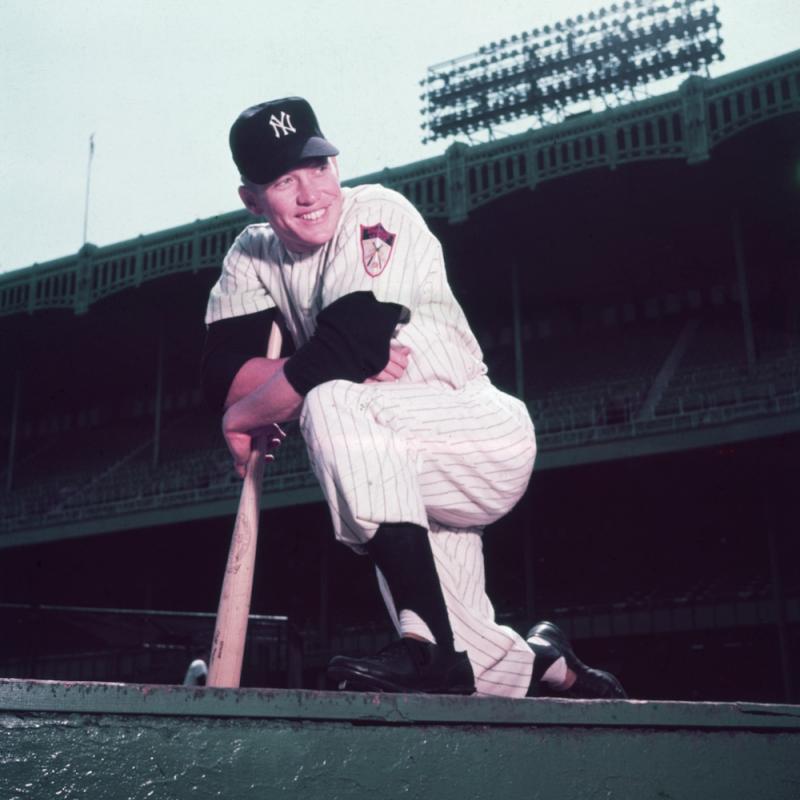
Baseball legend Mickey Mantle played for the New York Yankees his entire career, from 1951-1968. Mantle grew up in small Oklahoma town, but his personal life, including drinking and abandoning his family, did not always live up to his all-American image. Mantle's new autobiography is "The Mick."
Pianist and singer Bobby Short is a master of American popular song, singing classics from the likes of Porter, the Gershwins, Berlin, and Sondheim. He has the been playing at Cafe Carlyle in New York since 1968. He reached a new generation when he was in an ad for Revlon's Charlie perfume.
Dick Cavett is a television talk show host, comedian, and writer. He's had shows on ABC, public television, and cable television. He began his career writing jokes for Jack Parr and Johnny Carson. He is known for his esoteric guest and "intellectual" style.
James Farmer was one of the most prominent leaders of the fight for African American civil rights. Farmer participated in sit-ins in Chicago in 1942, and co-founded C. O. R. E. in 1943. He was involved in the Freedom Rides, and later focused on economic and political discrimination. He was briefly the Assistant Secretary of Health, Education, and Welfare for President Nixon, but quit after a year. Farmer currently teaches and consults of minority affairs. His autobiography is titled "Lay Bare the Heart: An Autobiography of the Civil Rights Movement."
David Marc is a television critic for The Village Voice and Atlantic magazine, and also a professor at Brandeis. Marc thinks that it is important to analyze television with more depth than is currently done. His new book , "Demographic Vistas: Television in American Culture," plays on the title of a Walt Whitman essay "Democratic Vistas." Marc views television and its demographic analysis as an "ironic" fulfillment of Whitman's call for an American art that focuses on the "average, democratic, and popular."
John Cage is an avant-garde musician known for his "chance compositions," which use "found" sounds. His music mixes Eastern philosophy with Western high-technology and eschews principles of harmony and melody. Cage is still a radical at 73.
Humorist and reporter Calvin Trillin is known for his food columns for The New Yorker, which have been collected in three books. Trillin also writes a humor column, "Uncivil Liberties," for The Nation. His second collection of these columns, "With All Disrespect," has recently been published.
Spalding Gray was already famous in experimental theater for his funny and erotically-charged monologues when he made his film debut in "The Killing Fields," about the American involvement in Cambodia. His experiences as a novice making the movie in Thailand inspired his new monologue "Swimming to Cambodia." The monologue contains stories of the real fighting in Cambodia.
Writer and humorist Bruce J. Friedman has written novels, plays, and screenplays. His screen credits include "Splash" and "Stir Crazy." He joins the show to discuss his career.
Cynthia Lennon was married to John Lennon from 1962 to 1968, and is the mother of Julian Lennon. Lennon has managed to make her a own career as a designer.
Mary Gordon writes literary fiction that manages to top best-seller lists. Religion plays a large part in her novels, and Gordon grew up Catholic and even considered becoming a nun. Today she has big differences with the church, but still considers herself a Catholic, if only in her mind. Her latest novel "Men and Angels," involves a babysitter driven by religion-tinged insanity.
Lyricist Sammy Cahn is one of the last survivors of the Tin Pan Alley tradition. His popular hits include "Bei Mir Bist du Schon," "Come Fly With Me," "Let it Snow," and "Three Coins in a Fountain," among others. Cahn has also worked extensively with Frank Sinatra. He joins the show to discuss his career.
Richard Stoltzman is a clarinet virtuoso. He was the first solo clarinetist to be presented in Carnegie Hall in 1982. Stoltzman is known for his unusual concerts, incorporating jazz and wearing informal clothing. He joins the show to discuss his life and career.