Philadelphia Inquirer editorial cartoonist Tony Auth recently illustrated a children's book called That Game from Outer Space. He sees both media as effective ways of deploying political messages.
Psychotherapist Myron Sharaf has written a biography on the researcher Wilhelm Reich, who developed the study of orgonomy. Reich worked for greater sexual reforms in pre-World War II Berlin before continuing his research in the United States.
The band's lead singer Tracy Nelson made her mark as part of the Berkeley rock scene. She has since moved to Nashville, where she has been exploring her interest in blues, R&B and country music.
The acclaimed musician was a featured soloist in Count Basie's big band. He was awarded an achievement award from his hometown of Pottstown, Pennsylvania. He looks back on his decades-long career as a working jazz musician.
Ray Fielding is a film scholar and cinematographer who developed the special effects for the director's recent movies. Fielding shares his experiences working on One from the Heart and Apocalypse Now.
Myrlie Evers' book about her late husband, the civil rights activist Medgar Evers, was recently adapted into a movie for public television. She talks about her upbringing in the South, her relationship with Evers, and her own work to advance African American civil rights.
Christopher Cerf's educational songs for children are featured on the television show Sesame Street. He tells Fresh Air's Terry Gross about how he chooses his subject material and the popular songs he pays tribute to. An album of Sesame Street music, titled Born to Add, features many songs he wrote and performed.
William Schimmel is the accordionist for the Tango Project, and disagrees with those who malign the instrument and the dance/music. Schimmel has written a tango mass for accordion, conducted and performed in the Joseph Papp production of the "Three-Penny Opera," and composed the musical "Kill." Schimmel lives in New York and commutes to Philadelphia where he is the dean of the New Power School of Music.
Seymour Hersh is an investigative journalist known in part for breaking the story of the My Lai Massacre for which he received a 1970 Pulitzer Prize. Hersh also won Polk Awards in 1969, 1973, 1974, and 1981. Hersh is currently the national correspondent for The Atlantic, and his new book is "The Price of Power: Kissinger in the Nixon White House." The book studies Kissinger's use and abuse of power during his international negotiations and his power plays within the Nixon administration. Hersh joins the show to discuss his book and career.
Bill Bradley is a United States Senator from New Jersey. Bradley started his career as a professional basketball player and was sworn-in as the Senate's youngest member in 1979. Bradley has served on the Energy and Finance Committees, co-sponsored the Fair Tax Bill, been one of the architects of the windfall profits tax on oil, and brought a contract to the Philadelphia Navy Yard. Bradley is currently seeking Medicare reforms. Bradley joins the show to discuss his belief and legislative ideas; he will also respond to listener calls.
Sigi Shapiro is the Executive Director of the Pennsylvania Coalition of Citizens with Disabilities, a coalition of 25 groups representing 70,000 Pennsylvanians. Shapiro joins the show how she became an activist in the disable rights movement and some of the current issues she is organizing around.
John D'Emilio is an Assistant Professor of American History at the University of North Carolina. His latest book, "Sexual Politics, Sexual Communities," is an historical analysis of the creation of gay activism from 1940-1970. The book looks at how World War II helped create a gay community, the politics and organizing styles of early homophile groups, such as the Mattachine Society and the Daughters of Bilitis, and the impact of the civil rights movement, student activism, and feminism on gays. D'Emilio joins the show to discuss his research and conclusions.
Cal Thomas is the Vice-President for Communications of the Moral Majority. The Moral Majority was funded by Jerry Falwell and a coalition of pastors, priests, and rabbis in June of 1979. Thomas describes the group as a political organization dedicated to addressing the "erosion of traditional values" and the social problems the group believes results from the abandonment of "Judeo-Christian values." Thomas writes the group's daily radio commentary, material for its monthly newspaper, and serves as a spokesman for the organization.
Legendary ballerina Margot Fonteyn was a member of The Royal Ballet and danced professionally for an exceptionally long time. She has danced with partners such as Rudolf Nureyev. Fonteyn will host a series on public television "The Magic of Dance." Fonteyn joins the show to discuss her life, career, and contemporary ballet.
Husband and wife Jane Stern and Michael Stern spend much of their time on the road in search of good food and Americana. They have written several books about their travels including "Road Food" and "Horror Holiday." Their latest work "Goodfood" is about regional cuisine around the United States. Jane and Michael Stern will discuss Philadelphia and Middle-Atlantic cuisine and respond to listener calls.
Tenor saxophonist and composer Archie Shepp is known for his radical jazz and his radical politics. His recent work has emphasized interpreting the traditions from which his playing and writing is derived, including a blues and spiritual album with Horace Parlan and a tribute album to Charlie Parker "Looking at Bird." His latest album is "Mama Rose." Shepp is also a playwright, poet, and professor. Shepp moved to Philadelphia at the age of 7, and will perform a concert with McCoy Tyner at the Cool Jazz Festival.
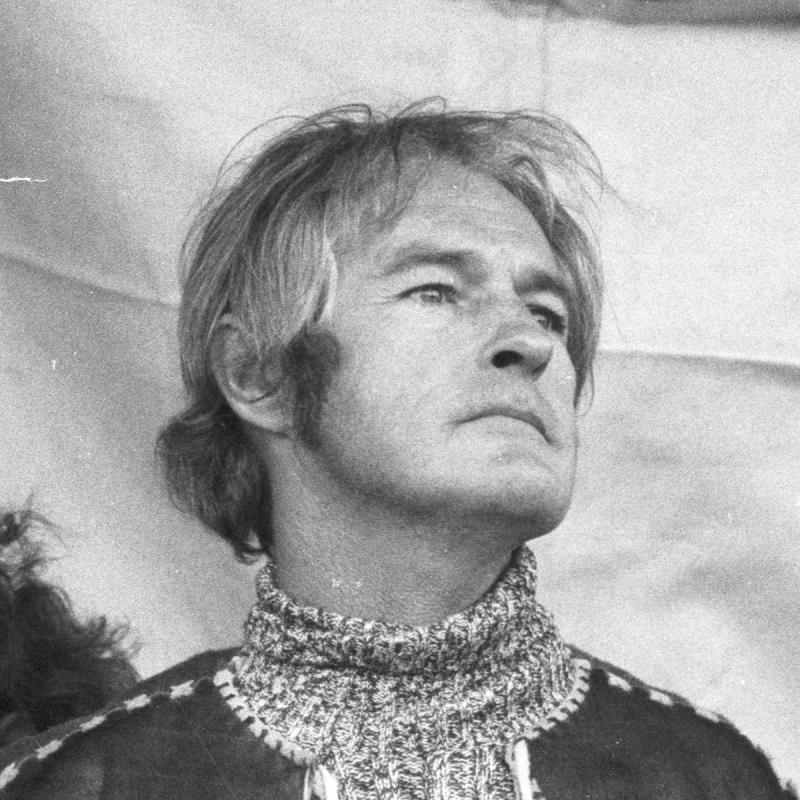
Psychologist Timothy Leary is the father of the psychedelic movement of the 1960s and its experiments with mind-altering drugs. In 1960, Leary joined the faculty of Harvard at the Center for Personality Research, where he analyzed the effects of psychedelics and personality. As part of his research, introduced L.S.D. and other psychedelic drugs to many, and also used them himself. Leary was eventually asked to leave the university, and later served time in jail on drug charges. After his release, Leary went a tour debating one of his nemeses, G. Gordon Liddy.
Peter Tork was the guitarist and keyboardist of The Monkees, and band put together for a 1960s television program of the same name. Tork currently performs solo as well as part of his band the Peter Tork Project. Tork joins the show to discuss being a Monkee and his career since the band's demise.
John G. Adams became the Counselor of the Army in 1953 and had to work as the liaison to Joseph McCarthy. His experience with McCarthy turned his indifference towards the Senator to active resistance. When McCarthy threatened members of the Army in 1954, Adams leaked documents that revealed McCarthy's illegal harassment of Adams. This led to the televised "Army-McCarthy Hearings." Adams has written a new book about this period and his experiences, "Without Precedent: The Story of the Death of McCarthyism."